


You won’t be surprised to know that I mostly bring educational games into our home.
Some have been awesome.
Others… not so much.
Here are the ones that are actually worth spending money on.
Spoiler: I will not say Scrabble. Not even once. (Even though it’s pretty awesome)
Titles are hyperlinked to games. Contains affiliate links.
PS. Games are not in age order — if you have littles don’t worry there are some for you!
Shakespeare Game (Ages 8+)
If you’ve followed me for any length of time, you know the Bard is practically a family friend around here.
We got this game over Christmas and it was an instant hit. Players collect lines from Shakespeare’s plays and then perform them to earn money (in the game). There are strategy elements — blocking, stealing, etc. — but we mostly focus on collecting and dramatically performing. My kids were already in love with Shakespeare. It’s worth introducing him before you start this game. Need help? Read: 8 Year Olds Can Learn Shakespeare.
I’d say 8+ is ideal, though younger kids can join with help.
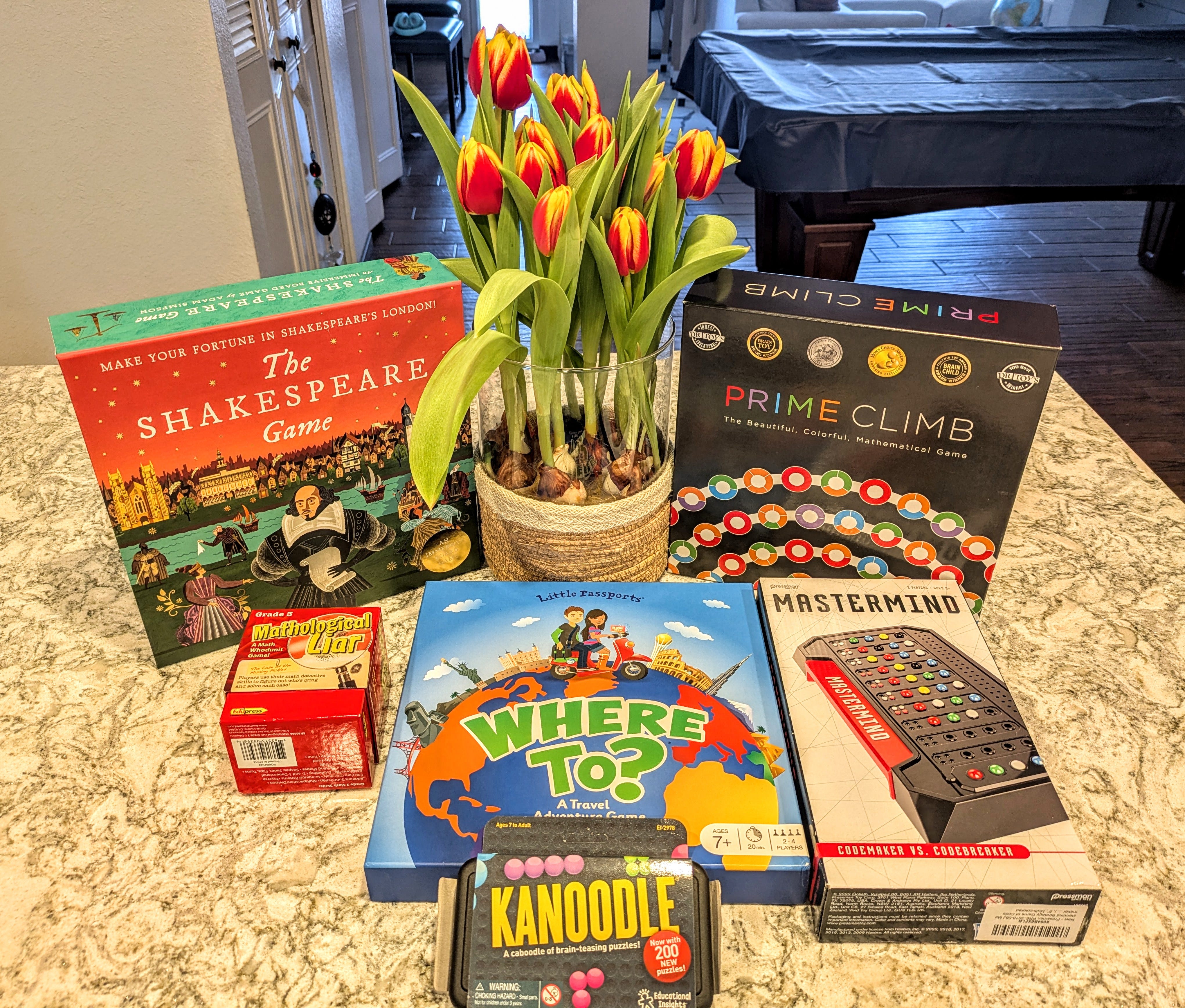
Prime Climb (Ages 8+)
This game is brilliant on so many levels.
It’s especially powerful for 3rd–4th graders because it helps them break numbers into prime factors — foundational for fractions, long division, and deeper number sense. Kids should have basic multiplication familiarity, but beyond that it’s accessible and surprisingly fun.
If you want number fluency without worksheets, this is it.
Where To? (Ages 7+)
A geography-based game where kids travel the world collecting destinations. When they claim a space, they read about a cultural event connected to that location.
It feels a bit like Ticket to Ride — but global, and with much richer exposure to world cultures.
Geography plus cultural literacy? Yes, please.
Sight Word Bingo (Ages 4–7)
My kids love bingo in all its many forms.
This version is wonderful for emerging readers who need repetition with high-frequency words. Yes, sight words require memorization — and this makes it joyful instead of tedious.
If your kids love Bingo as much as mine, I’ll give my favorite ways to use FREE Bingo games soon.
Numbalee (Ages 4+)
This one is wildly versatile.
We’ve used it for addition, subtraction, multiplication, and division. Put a random number in the middle, start adding (or subtracting) to it. Sometimes we play competitively; sometimes we do a collaborative free-for-all where everyone builds together.
It’s a bit like Scrabble — but with numbers. And having number tiles around opens up a thousand other math games you’ll invent on the fly.
*Numbalee appears to be on backorder right now — HERE are some wooden tiles that would work just as well.
Kanoodle (Ages 5+)
You might be surprised to see this here because it doesn’t scream “educational.”
But it trains visuospatial working memory — a critical (and often overlooked) foundation for mathematical thinking. For more read: Improve Your Kids’ Math Without Doing Math.
Logic puzzles like this quietly build serious brainpower.
PS. If you have more than one kid, think about getting the competitive version HERE. I wish I’d done that.
Mathological Liar (Grades 2-7)
This is one my kids genuinely love!
Each round presents a “whodunit” scenario. One character did the math incorrectly — and that person is the liar. You have to solve the problems to figure out who it was.
They’re grade-level specific (above link is for grade 3, but they come in many grades).
My kids prefer to play a grade level down — just like rereading easier books builds fluency. That’s completely fine! Good even. Keep that in mind when purchasing.
Shut the Box (Ages 4–8)
A classic for early math facts.
We played this constantly during the preK–2 years. Roll the dice, flip the tiles. You can extend it by working backward for subtraction or even division.
Simple. Fast. Fun way to do early math facts.
Alphabet Go Fish (Ages 4–6)
My kids loved this long after they technically “knew” their letters.
We also adapted this when we were learning sign language & played the game using hand signs. Though we’ve never used it this way, you could do the same for foreign languages that share the English alphabet.
Pro tip: For early readers, use the letter sounds rather than the letter names (buh… not “B”). It makes the game phonics-rich instead of just alphabet recognition.
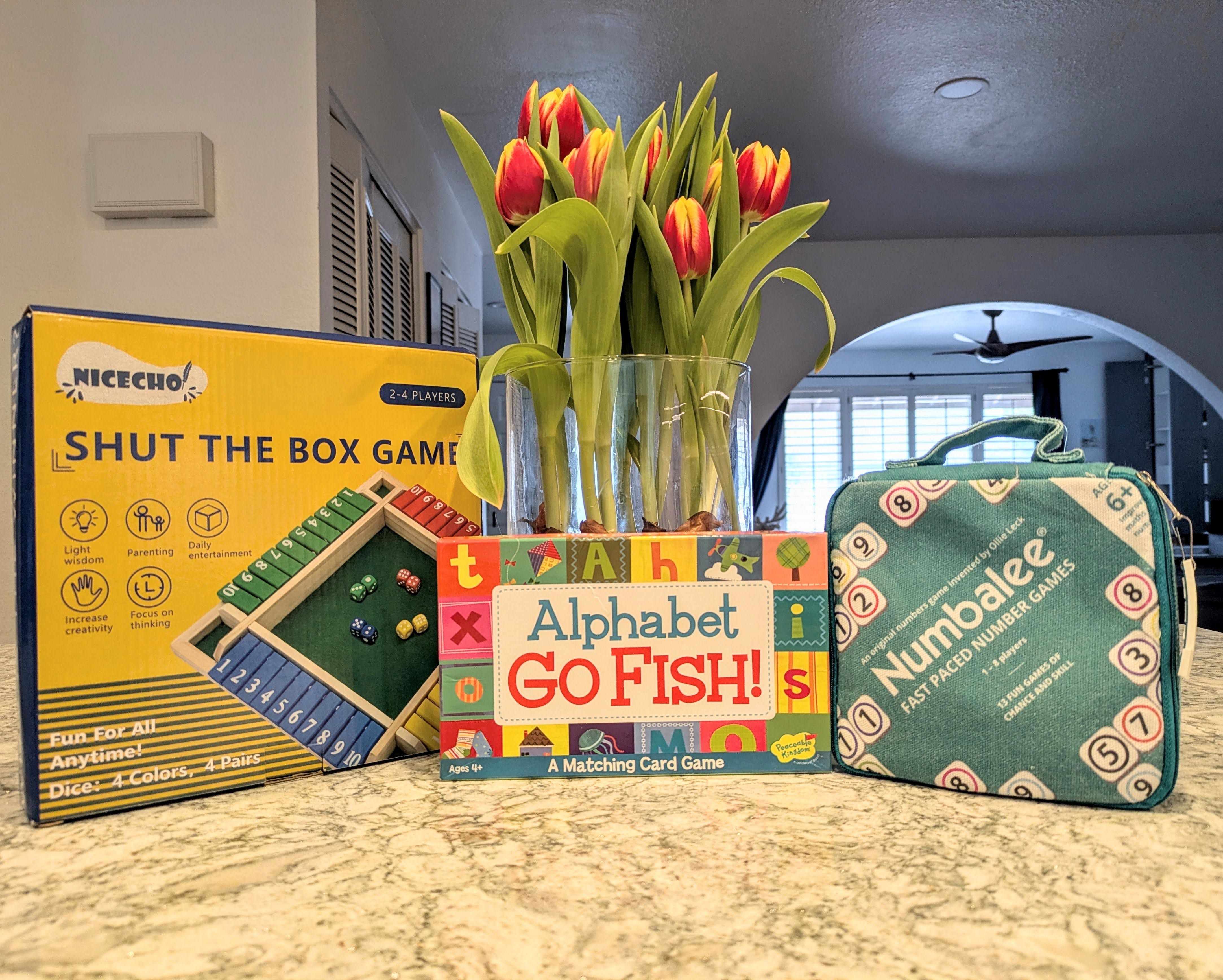
Mastermind (Ages 6+)
An excellent logic game.
Highly recommend. It builds reasoning, hypothesis testing, and strategic thinking. Also resilience for your perfectionist kids (I’ve got one of those!)
For my beloved companions: I’ll give you a FREE version of this game in a minute — including how to simplify for 5 year old and make it hard enough for your teenagers!
BONUS: You Laugh You Lose (All ages)
Not educational.
Utterly delightful though.
The goal is to make other people laugh. We play “You Laugh, You Win” — if you laugh first, you get to go next. Fantastic way to lighten the mood around the house — and great or parties.
Joy should absolutely be a part of every day friends.
The right games don’t just pass the time.
They build thinking.
They normalize challenge.
They make learning delightful.
And that’s the real goal, isn’t it?
✨For My Beloved Companions
Below, I share 6, FREE math fact games I made up when my kids were little. They require things you’ve got around the house (crayons, a deck of cards) — even better your kids get to help make most of them!
Most you can alter to do any type of “fact” knowledge — spelling, history, homonyms, letter sounds — almost anything really!