


If your first reaction to AI was to keep your kids as far away from it as possible, you’re in good company.
Ours was, too.
Classical education has been our foundation for years. We believe children should read the great books, learn history, study mathematics, write well, and develop the ability to think clearly. We also believe that education is formation and that our children’s character matters just as much, if not more, in their education as the skills they gain.
Thus, our AI education mostly consisted of teaching our children that it wasn’t something to be trusted.
In the early days of AI, our favorite family game was called Make Alexa Lie.
The girls would ask Alexa questions until they caught it making a mistake. Then came the real challenge: getting it to admit that it had lied. One time they legit broke it. It had to reset because it got so confused. They were pretty proud of themselves.
It was a wonderful game. They practiced logic, questioned answers, and learned not to take everything a machine told them at face value.
It seemed like a Win/Win. Until it didn’t.

It gave our kids a rather terrible impression of AI. Which, admittedly, was the point.
But eventually, it started to feel a little dishonest.
My husband is a technology consultant who builds innovative solutions for large companies and industry leaders. He uses AI every day. It allows him to create faster and better than ever before.
And it got me thinking: Don’t we want our children building incredible things too?
Are we really going to let them grow up without learning to use one of the most powerful tools humans have ever created?
Obviously not. Our children weren’t going to avoid AI. They were going to learn to use it — and use it well.
Not doing their homework with AI (that’s still outlawed). But using AI to build things of value. To create, solve problems, and eventually build businesses of their own. (More on that soon.)
But where to start?
Should we just give them chatGPT or Claude and let them run wild? That seems ill-advised and honestly dangerous.
So we started somewhere you might not expect: programming.
In a world where most think programming is obsolete, my husband disagrees. He notices a striking difference between people who use AI with a programming background and those who don’t.
Experienced programmers understand how software is built. They know how to break a problem into pieces, how different systems fit together, and how to think about the person who will actually use what they’re building. That changes how they work with AI. Even without prompt training, they get better results because they’re more precise. They spot when a solution is flawed and troubleshoot more easily, because they understand how the underlying code works.
And this isn’t limited to programming. We’re seeing the same pattern across fields. People with deep knowledge and experience are better positioned to use AI effectively than people who are are novices.
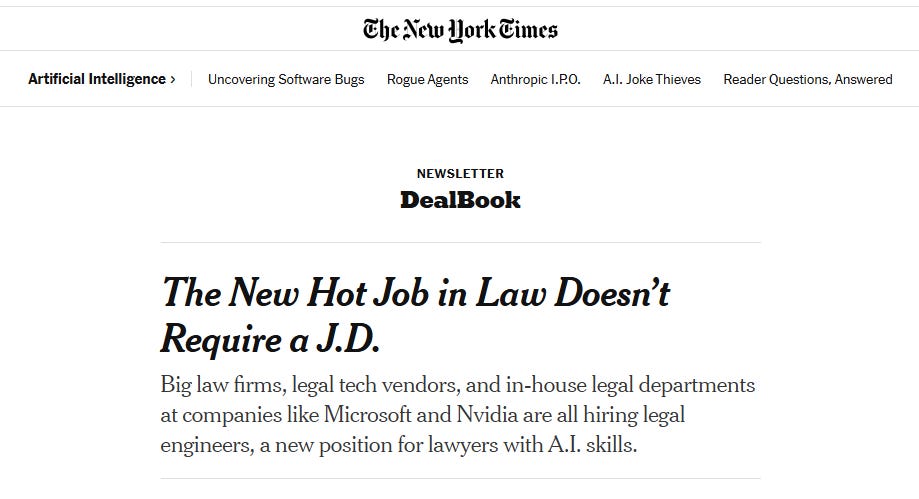
Just this week the New York Times reported on a new job category — legal engineers” — created by lawyers who combine legal expertise with AI skills. Many of these roles are paying in the mid-to-high six figures.
We are teaching my kids programming so they learn to think like programmers.
This semester, we enrolled the girls in private Python tutoring. They started by building simple games and next year they’ll move into writing code for robots of their own design.
If you’ve followed our family’s adventures for long, you probably see why I love this.
The girls have spent years making their own toys. Cardboard boats, paper dolls, doll clothes. This represents a natural extension — but one that teaches them the very skills that will help them stand out amongst a crowded field.
We’re still doing the great books, the history, the writing, and the math. Programming isn’t replacing that formation. It’s giving them another language for building and solving problems.
If you are like me, you still have questions!
I spent an hour picking my husband’s brain: How much programming is enough? Which languages should children learn? Can AI actually help children become more innovative, or does it make them more dependent on existing ideas?
And the question I was most curious about: Should programming languages replace learning a foreign language? My husband speaks multiple of both, so I thought his answer would be particularly interesting.
I’ve included the full conversation below for paid subscribers.
And if you’ve ever wondered what our home life is like, or the kinds of conversations my husband and I have, often in front of our children, I think you’ll enjoy this one.
Because we’re not interested in raising children who are afraid of the future. We are raising leaders that will shape it.
PS. I would love you to share my work! It helps me grow and support my family. Thank you for subscribing. I’m honored you are here.