


I was a STEM kid, but then I had a daughter who loved words.
Let’s start with a decades old embarrassing memory.
I was sitting in high-school English class, having just finished a Faulkner story (Don’t ask me which one). What I remember is this: a classmate confidently announcing that the bird in the story symbolized youth and fragility.
I thought, Symbolized what? Did we read the same story? It’s just a bear walking around the woods, right?
That moment has stuck with me.
Not because I felt dumb—although I did—but because it revealed a world I couldn’t yet see. A world behind the words. A world I didn’t want my kids to miss.
So when I became a homeschool mom, I read differently. I read to my kids early and often. Poetry at breakfast. Fables in the car. Classics before bed. Stories I once found intimidating became familiar territory—for me and more importantly for my children.
Their literary appetites grew and grew.
We read Dickens, Twain, Hemingway—before their 10th birthdays.
This past Halloween, we read The Legend of Sleepy Hollow - the original. It’s knotty, archaic, and dense in places. Even I had to stop for the dictionary. But our conversation afterward? Electric.
What’s real? What’s imagined?
Why would Washington Irving write a ghost story?
What does fear do to a community? To a young nation?
My kids saw layers I never saw at their age. They saw meaning—because meaning is now their default.
Turns out if you trust kids with great stories, they grow into great readers.
But the high-school version of myself is still in my head, What am I missing? Is there more meaning, more symbolism, more layers???
So, I picked up the book How to Read Literature Like a Professor. Phenomenal read. Highly recommend (link above).
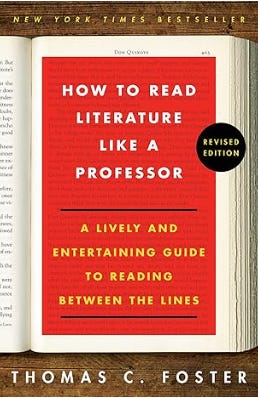
Unsurprisingly, Thomas Foster said that to read like a literary scholar you have to be well read—really well read.
If you are anything like me, that statement is stress-inducing.
There are millions of books in the world. I can read any of them to my children, but I can’t read all of them.
Even if I limit us to “classics”, let’s say written before 1950, we’re still talking about hundreds of thousands of books, an overwhelming mountain.
But then the Thomas Foster said something that changed everything: There’s no such thing as a wholly original work of literature.
Almost everything is a reimagining or echo of what came before, and those origins can be traced back to a core set of foundational texts (at least in the western tradition - and since you are reading this in English that’s YOU).
If you want to understand great literature, you have to be well read but not necessarily in the “I’ve read a thousand books” sense, but in the “I’ve read the foundational books that shaped everything else” sense.
So the question becomes👇
Which stories matter most?
Which ones built the modern literary world our children live in?
Which ones are still being echoed, copied, twisted, reimagined today?
The list is smaller than you’d think, but I warn you - some of you are NOT going to like this list.
It will seem old, stuffy, religious (gasp!), and maybe even a smidge impossible….
But every western writer for hundreds of years has drawn from these four great wells.
Shakespeare (duh)
The Bible (yes - that Bible)
Ancient Myths (Greek, Roman, a little Norse & Egyptian)
Global Folktales (the rest of the world matters too)
I’m not saying that you should only read these.
I’m saying every story you’ve ever loved is secretly arguing with one (or more) of these four ancient ancestors.
OK, Thomas Foster is arguing that, but I agree.
Let’s take a quick look at each of these pillars—and why they matter so, so much.
Don’t worry, I’ll show you how to quickly and easily introduce these to you children at the end. SPOILER: We won’t start with Macbeth.
✨Shakespeare
William Shakespeare’s works are the bedrock of Western literature. Shakespeare didn’t just write plays; he articulated the human condition. Jealousy, ambition, betrayal, grief, love. Writers don’t copy Shakespeare because they’re lazy; they copy him because he already mapped the darkest, funniest, most heartbreaking corners of the human soul.
Modern Stories Touched by Shakespeare (to name a few)
The Lion King — Hamlet, West Side Story — Romeo & Juliet, 10 Things I Hate About You — The Taming of the Shrew, Brave New World — The Tempest, The Catcher in the Rye — Hamlet, Frankenstein — Macbeth + Hamlet, The Secret History — Julius Caesar + Hamlet, Lord of the Flies — Macbeth, Animal Farm — Julius Caesar, The Giver — The Tempest, The Hunger Games — Julius Caesar, The Outsiders — Romeo & Juliet, Bridge to Terabithia — Hamlet, Succession — King Lear, Breaking Bad — Macbeth, House of Cards — Macbeth + Richard III, The Dark Knight — Hamlet + Othello
✨The Bible
It doesn’t matter if you are a believer (though I know many of you are)—western writers assume readers catch biblical allusions. Think of the Bible as the most influential piece of world literature in English in the last 400 years (PS. King James is only 400 years old).
Works of literature become deeper when you crash them up against their predecessors. How does The Giver, a story about a boy who learns his idyllic home is … well… not so idyllic, change when you compare and contrast it to Adam and Eve eating from the tree of knowledge—leading to them seeing their entire world differently? The Giver isn’t Adam and Eve, but it is a story of learning things you shouldn’t and the consequences of those actions. Discussing these stories together makes both richer and deeper.
Modern Works Touched by the Bible (to name a few)
The Chronicles of Narnia — Christ imagery, allegory, redemption, East of Eden — Cain & Abel, sibling rivalry, moral choice, The Road — apocalypse, father/son parallels, survival & hope, Life of Pi — allegory, faith, sacrifice, The Giver — Edenic structure, fall from innocence, The Lord of the Rings — messianic & stewardship themes, Harry Potter — resurrection motifs, self-sacrifice, Dune — chosen one, messiah complex, The Matrix — Neo as messiah, prophecy, rebirth, Superman — Moses + Christ imagery, Les Misérables — grace, redemption, A Wrinkle in Time — light vs. darkness, good vs. evil, The Handmaid’s Tale — biblical theocracy, moral allegory, To Kill a Mockingbird — moral law, conscience, The Little Prince — parable structure, The Tale of Despereaux — light vs. darkness, moral courage
✨Ancient Myths (Greek, Roman, a little Norse & Egyptian)
Greek, Roman, and Egyptian myths are the earliest attempts (OK, the west’s earliest attempts) to explain the world through story: quests, riddles, hubris. Every time a kid meets a three-headed dog, a boy who can’t stop flying too high, or a girl who opens a box she was explicitly told to leave shut, they’re shaking hands with a 3,000-year-old template. Harry Potter’s scar? Odysseus’s wound. Luke Skywalker leaving Tatooine? Theseus leaving Crete. Same roadmap.
My daughter and I started 20,000 Leagues Under the Sea yesterday. I’m a few pages in; it’s steeped in mythical allusions. How will knowing Greek mythology change the experience of this story, the depth we’ll see, the conversations we’ll have? A lot — I can’t believe how many of these references I would have missed just a few years ago.
Modern Works Shaped by Ancient Myths (to name a few)
Percy Jackson — Greek myth (direct), Harry Potter — Greek/Egyptian myth (phoenix, Cerberus, centaurs, prophecy), Moana — ocean deity + hero’s journey, The Hobbit & LOTR — mythic world-building, Star Wars — hero’s journey = myth formula, Dune — prophecies, desert trials, messianic myth, Circe & The Song of Achilles — Odyssey retellings, Hercules — Greek myth, Wonder Woman — Greek gods, Thor — Norse mythology, Black Panther — ancestral plane, mythic kingship, The Hunger Games — Theseus & the Minotaur, O Brother, Where Art Thou? — Odyssey, Fablehaven — creatures from mythic lineages,
If you’re starting to notice repeats in the modern works—you are 100% right—that’s exactly how layered great stories are.
✨Global Folktales
Folktales are distilled human wisdom. They carry patterns of justice, wit, trickery, and perseverance. And they reveal how universal our stories really are. Kids learn that cultures separated by oceans wrestle with the same questions—even if they might come to difficult conclusions: How should we treat each other? How do we defeat evil? Folktales give children a sense of belonging to the big human story.
But folktales are special for another reason. Global folktales introduce different ways of thinking. My family is currently reading Where the Mountain Meets the Moon. Part of what makes it so special is the use of Chinese folktales. These beautiful stories are filled with Eastern - not Western - philosophy, values, and ethics. Reading stories from around the world doesn’t just show us how we are similar, but how we are different - and how that’s beautiful too.
Modern Works Shaped by Global Folktales (to name a few)
Cinderella — Germany/France, Sleeping Beauty — France, Beauty & the Beast — France, Mulan — China, Snow White — Germany, The Little Mermaid — Denmark, Aladdin — Middle East, Frozen — Denmark, Spirited Away — Japan, Kiki’s Delivery Service — Japan, The Tale of Despereaux — France, The Graveyard Book — England/India, The Sea Beast — maritime cultures (various), Where the Mountain Meets the Moon — China, The Wild Robot — North America, Every trickster character (Loki, Anansi, Bugs Bunny) — Norse/West Africa/North America
🌺How Has This Affected My Kids?
We’ve been following the classical model of education for a while now, so reading Greek, Roman, Egyptian myths with Biblical stories in the mix is pretty standard fare. Global folktales from around the world have been a favorite of my children forever (my favorite resources coming), and as I discuss in my articles 8 Year Olds Can Learn Shakespeare and High School is too Late for Shakespeare, the bard has been become a staple in our lives. We don’t just read these, but I do prioritize them—and repeat them often to keep them in memory.
How has it shaped our world?
My children have started to make associations and comparisons naturally without me bringing it up. As we read Where the Mountain Meets the Moon, the girls point out, “I’ve heard that before.” When we read Harry Potter, they girls pointed out the numerous allusions to Greek & Roman mythology in names, places, and a certain three-headed dog.
As they age, they’ve started to point out how the stories are different. Recently, we watched The Fantastic Mr. Fox. The girls pointed out they’d heard that story before but in the original folktale the fox gets away easily, whereas the movie drags the conflict out. We got to have a conversation about why the movie artists might have chosen something different. Which did they like better (the story) and why? What was different, and how was that important?
This type of discussion is exactly the kind of intellectual conversations had in the ivory towers, but more importantly it teach your children how to critically evaluate the rich, complex world around them.
I know the beginning this journey can feel overwhelming—but these types of conversations will begin to pop up naturally as long as you feed them the fertile soil of foundational texts.
You don’t need a fancy degree or even to be an expert.
🌺You just need to start.
Below, are my favorite resources for a gentle introduction to these beautiful, foundation texts—many of which are completely free.
This part is a gift to those who generously support my work. Memberships are 30% off until January 1st, if you’d like to join us for 2026.