


Last week we went on an epic fall break through three national parks and Disneyland. But what will stay with me most isn’t the Mosaic Canyon hike or the volcanic islands. It’s what I learned watching my brother and his wife parent their family of eight.
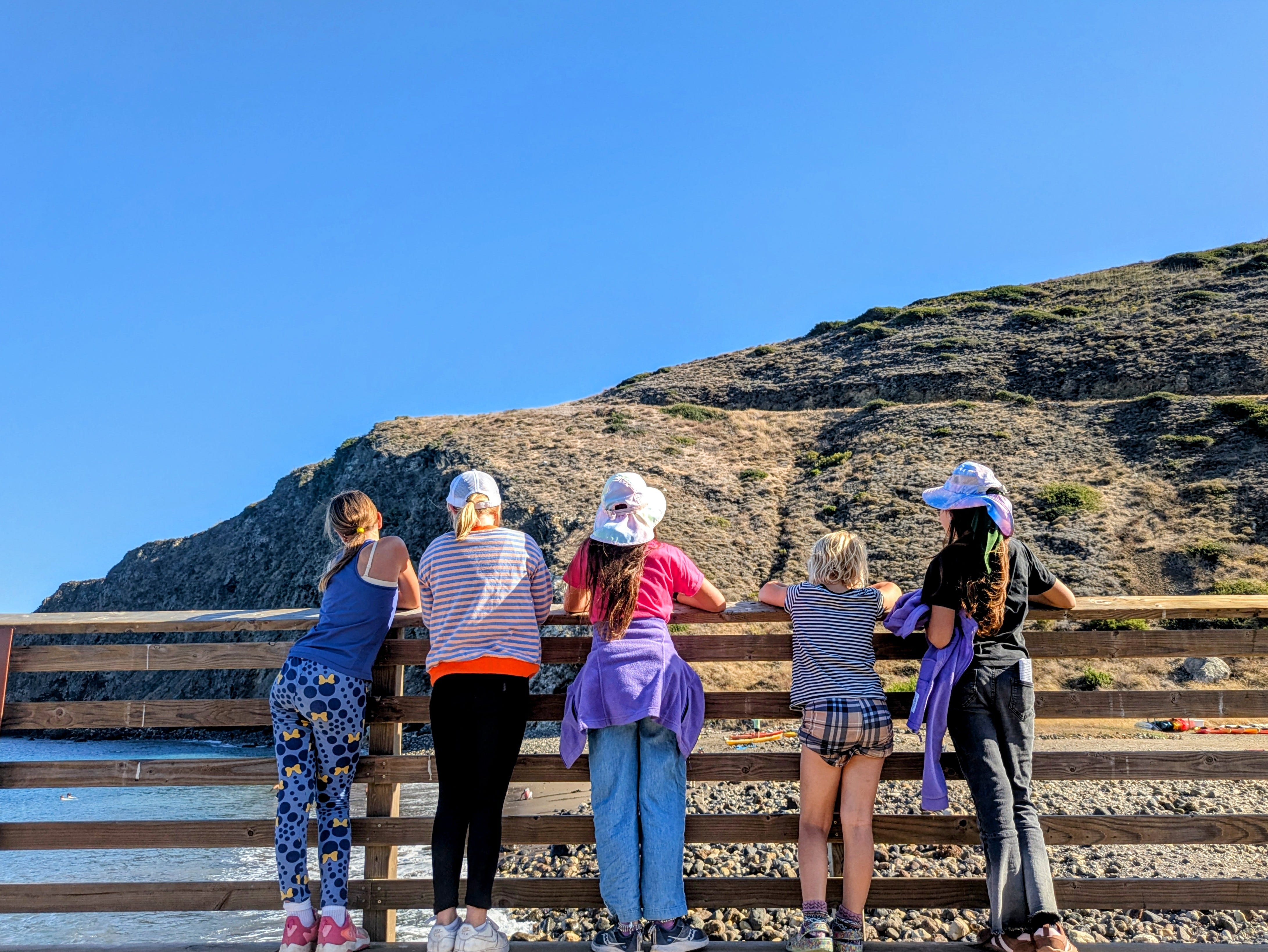
They squeeze so much life out of every day. They fill every space they’re in —even narrow canyon trails — with the most beautiful noise. It’s loud and intense, but their laughter and love take up a lot of space.
I found myself in awe of this messy, joyous group. I watched them parent with a patient calm that was somehow both warm and grounded. It was a marvel to behold.
There’s something special about large families — and not just my brother’s. Last year, I interviewed five other big-family parents for my podcast.
They are all a little like parenting gurus: not because they have it all figured out, but because daily life gives them plenty of practice.
Here are the lessons I’ve learned from large families — and he habits I’m bringing home.
✨The best teacher in your house might be a child
On our very first hike, I watched with some concern as my three-year-old nephew got into a prickly spot a bit too high on the canyon wall. It wasn’t his parents who came to the rescue, but his eleven-year-old twin sisters.
They consoled him with “You’re OK” and “Just a minute, I got you,” mimicking that calm parental voice. They safely got his feet back onto the ground.
To be clear, their dad was standing right there the whole time. He could have pulled his son down himself, but instead he watched carefully as his daughters helped. They handled it beautifully.
He gave them room to discover that they were capable of doing something difficult — and that he trusted them.
Every large-family parent I’ve spoken to has mentioned how much teaching the older children do. They read to younger siblings, help with baths and meals, pass along what they’ve learned in school, and help with homework.
This doesn’t just help younger children. It solidifies and deepens the older kid’s knowledge, too. It also builds confidence and gives them a meaningful role in the family.
My own children are so close in age that they don’t get many opportunities to teach. But on our trip, I watched them hold their cousin’s hands, and my nine-year-old patiently teach her kindergartener cousin simple origami designs, over and over.
We often think of parenting as a one-to-one relationship between adult and child. But children can be powerful resources for one another.
A family can become a community of learners, not a queue of children waiting for a parent’s attention.
As my oldest approaches babysitting age, I hope to find more opportunities for her to mentor young children. What an incredible gift—to be trusted with someone else’s growth.
✨Your children need to be needed
In smaller families, it’s tempting to do everything ourselves — the cooking, cleaning, managing. It’s often even faster, and we don’t want to burden our children with mundane tasks. But in making life easier for them now, we are taking away opportunities for them to be capable tomorrow.
After several large families gave me the same advice, I started asking my children to do more around the house. They thrived. They didn’t even complain — much. They like making breakfast. They are happy having more control over their school days. They aren’t in love with sweeping the floor or unloading the dishes, but it’s clear they feel more a part of the everyday flow of the household.
I spoke to the eldest of six, now a mother raising her own kids. She said it shocked her how few of her friends knew how to do basic things like laundry. She’d been helping her parents with accounting and taxes since she was fourteen. She now runs her own business.
We want children to become capable, generous adults. Those qualities don’t appear on their own at eighteen. Children develop them by being needed now.
My kids will continue to take on more responsibility. I’ll still do the bulk of the work, but I want them to grow into people who can lead, create, and contribute. That starts at home.
✨Not every hard moment needs fixing
Getting a large family to all agree on—and like—whatever you’re doing is nearly impossible. With a smaller family, you can act more democratically. If one of the four of us doesn’t want to do something, we often don’t.
But if one of my brother’s children isn’t super keen on the hike, we keep going.
To those of us used to catering more directly to our children’s preferences, this might seem harsh, but it doesn’t feel that way from the inside.
I spent most of my time in the “straggler” group with my brother. It usually included one child who wasn’t fully enjoying the activity. But that presented an opportunity: the chance to play games or find other ways to explore the area.
I told those kids more about rocks than they probably wanted to hear, but we all finished the hike.
They got to practice moving forward when something was uncomfortable.
I will continue to listen to my children’s thoughts, but I’m also going to try harder to press forward on activities I know are good for them—even if they don’t like every moment.
✨Setbacks don’t get to run the day
Over the course of a week, I witnessed only one stressful moment. My sister-in-law lost her watch, which was important to her. They looked for ten minutes, but it was gone, but we still had a full day ahead of us.
I watched her set the loss aside, put on a smile, and keep going.
In that moment she showed her children that setbacks happen, and we don’t let them ruin the day.
Parents of large families get a lot more practice on this than the rest of us, but I for one am going to try to be more resilient when things go imperfectly.
✨What gets your attention grows
Parents in large families don’t get involved in every little sibling tussle. If they did, they’d probably never get anything done. The children are left to manage many of their disagreements.
That doesn’t mean anything goes. Clear boundaries still exist, especially for younger children. There is no hitting or biting. I watched my sister-in-law take her 3 year old outside until he could return calmly.
But within those boundaries, children get room to work things out.
And parents get to make choices about which behaviors they reinforce. You’ll get more of what you encourage.
My nieces and nephew are always laughing and making jokes, and that reflects the culture their parents have cultivated. Their parents notice those moments and genuinely enjoy them.
It’s a reminder that family culture doesn’t emerge by accident. It grows out of what we notice, what we reward, what we tolerate, and what we model ourselves.
I’ll be paying closer attention to the behaviors I reinforce — with my attention and with my own example.
✨Your marriage is teaching, even when you're not
The culture children grow up in isn’t shaped only by how we treat them. It’s shaped by how we treat one another, too.
I love the relationship my brother has with his wife. They support each other, but it’s more than that. They call out the things the other does well.
One particularly early morning on the road, my brother recounted the previous evening. My sister-in-law had been trying to plan the next day while he was “listening” — but mostly falling asleep.
He laughed at himself as he told the story, then added, “She’s much better at that. She always says, ‘I’m tired—can we do this tomorrow?’ I need to be better like that.”
Finding strengths in his partner seemed completely natural to him.
His children see that, too.
We spend so much time thinking about the lessons we deliberately teach our children. But they’re also watching how we treat the people closest to us.
I came home wanting to do a better job of calling out the things my husband does well and making sure he knows I value him.
✨A joke did what years of lectures couldn’t
For years, I’ve been trying to get my children to stop comparing themselves to each other.
On our last morning together, I watched my brother accomplish the same thing in single sentence.
As we sat for breakfast, he gave a sweet compliment to one of his twins (let’s call her Twin 1).
From across the table, Twin 2 immediately started asking, “Daddy, what did you say? What did you say?!”
Without missing a beat he turned to her and said, “I was telling her that you are clearly the superior twin.” Everyone lost it laughing. Both girls were grinning.
In one playful line he took the tension out of the air.
Later, once the moment had passed, I watched him quietly find Twin 2 and give her a compliment of her own.
He’d managed to teach them two things at once.
You are deeply loved for exactly who you are.
You don’t need to beat your sister to matter.
He taught me something too.
I’d been trying to lecture my girls out of comparing. My brother reminded me that sometimes a little humor teaches what a hundred lectures cannot.
✨You don’t need tons of children to build a family like this.
You can start today, by asking a little more of your children, making room for laughter, and showing them what it looks like to love and serve one another.
Small choices, repeated over years, become a family culture. And that culture shapes who our children become.
I came home inspired by the family my brother and his wife are building —and reminded that the family we dream of doesn’t happen all at once.
We build it, one small moment at a time.
~Dr. Claire ♥️
PS. I would love you to share my work! It helps me grow and support my family. Thank you for subscribing. I’m honored you are here.

I learned a lot being number 4 of 5 and also from my dad’s family 6. Very true!