


I’ll never forget my daughter’s first real sentence.
She’d been “writing” for years at that point. She’d copied sentences and written breezy descriptions of dogs and cats. But this was different. This was special.

Her curriculum asked her to write a sentence about a man in a boat. “Use adjectives,” it said. I was hoping for something like, “The old man sat in the big boat.”
She wrote, “The old man smelled of salt and sea.”
My jaw dropped — and our writing journey changed forever.
In Falling in Love with Writing, we focused on merging the physical act of writing with the mental act of thinking. The years from 8 to 10 are the payoff when writing comes fully alive. The linguistic centers of the brain are in their final growth spurt. You can fill their ears with increasingly complex books. Children still hang on your every word. It’s a wonderful, wonderful time.
So how do we harness this precious period of linguistic expansion while helping them become strong writers?
The answer may surprise you. It surprised me.
We teach them to tell great stories.
A bunch of you just sighed and thought That’s not nearly serious enough. My kid isn’t going to be a novelist. You’re not wrong, but you are also missing important context.
All great writing tells a story.
As an engineering professor my published scientific journal papers were telling a story. A technical, data driven story but a story nonetheless. In fact, my PhD advisor (my scientific father) would always start conversations about journal papers with “What story are we are telling?”
And we aren’t the only ones. The late, great C.S. Lewis also chose story to bring home the messages he’d spent decades trying to impart with essays. Today, few read his literary papers, but millions read The Chronicles of Narnia every year.
There’s nothing more foundational to great writing than the ability to tell a compelling story.
But before they can write a great story, children must first learn what great writing feels and sounds like… what it tastes like coming off their tongue.
And so that’s where we begin.
Fill Their Ears with Beautiful Language
Children cannot write language they’ve never heard.
My daughter wrote, “The old man smelled of salt and sea,” shortly after we listened to The Old Man and the Sea. I don’t think that’s a coincidence. Children naturally absorb the cadence, vocabulary, and imagery of the books that fill their lives.
Read aloud constantly. Read books that stretch them just a little beyond what they could read on their own. Rich language quietly becomes how words are supposed to sound.
Let Them Borrow Greatness
One of the oldest tools in education is also one of the simplest: copywork.
When babies learn to talk, they imitate us. Musicians learn by playing the masters. Artists begin by copying great paintings. Writing is no different.
Give your child beautiful sentences to copy. I had my kids keep a notebook of favorite sentences. Kids these ages love a new notebook! Whenever we encountered a line that makes us stop and smile, into the notebook it went. Along the way children practice spelling, punctuation, capitalization, and grammar almost without noticing. More importantly, they begin developing an instinct for beautiful prose and how to linger of words.
Let Them Memorize Beauty
Nothing transformed my children’s writing more than memorizing Shakespeare.
We didn’t begin there, of course. We started with nursery rhymes, playful poems, and little verses about bees and puppies. But as they grew, so did the richness of the language I asked them to hold in their memories.
There are a million poets out there. Why Shakespeare? He wrote to be spoken aloud. His language has rhythm and sounds like music. He slows you down with one phrase and sweeps you forward with the next.
Long before children can fully understand each passage, they learn that it matters what words sound and feel like. Eventually that music finds its way into their own writing.
PS. If you’d like to know how I introduce Shakespeare to children as young as 6, you’ll enjoy 8 Year Olds Can Learn Shakespeare.
Inspire Their Writing Through Beauty
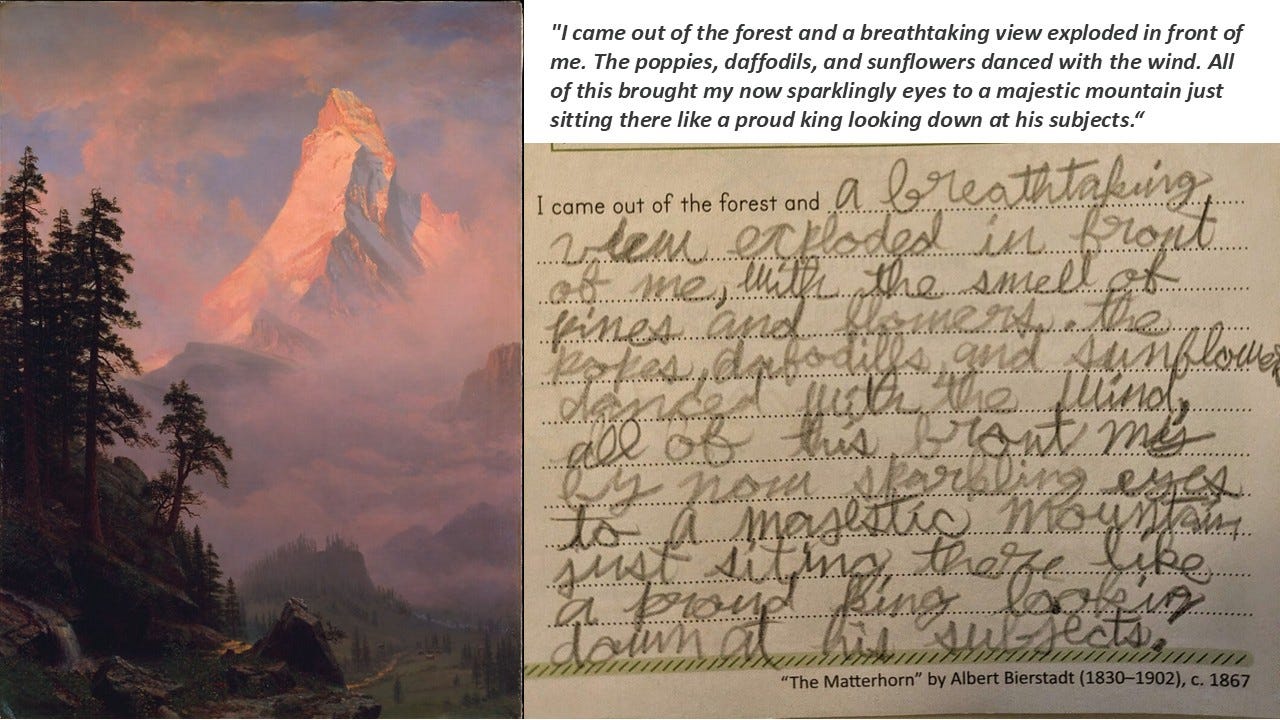
Once children have been surrounded by beautiful language, it’s time for them to bring forth their own beautiful words. One of my favorite exercises came from my daughter’s curriculum. She would study a beautiful painting, then answer questions like:
What would it feel like to stand there? What does the air smell like? Is the breeze cool or heavy? What can you hear?
The goal isn’t to describe the picture. It’s to imagine living inside it. Then use that to bring forth incredible words.
I still use this today. Whenever one of my children gets stuck writing, I simply ask them to close their eyes and step into the scene. Suddenly, they have something worth saying.
Teach Them to Love Revision
Great writing rarely arrives fully formed. Every writer learns to search for the right word.
One of my favorite exercises for teaching this is Variations, an exercise from the progymnasmata the ancient Greek pre-writing exercises. Start with a simple sentence and ask your child to improve it. Replace one word. Rearrange the order. Try a different verb. Add one vivid detail.
The point isn’t perfection. It’s helping children discover that writing is built one thoughtful choice at a time. Eventually they’ll begin making those choices without being asked. For an entire post on this incredible tool see Teaching Children the Art of Powerful and Precise Writing.
Tell Old Stories Before Writing New Ones
Before asking children to invent stories, ask them to retell great ones.
Aesop’s Fables are perfect. In just a few sentences they establish a setting, introduce a conflict, and arrive at a memorable conclusion. Teach your child to tell the story in their own words. Not only will they strengthen their writing, they’ll get a flavor for how stories are built. What they are supposed to feel like when you get to the end. Reading great books will do this too.
Only after children have lived inside many good stories do we ask them to tell their own.
Then Let Them Fly
There is plenty more to teach. My children wrote research papers about their favorite animals, learned punctuation, grammar, outlining, and revision (things I’ll cover more in the Q&A).
Those skills matter. But in these early years, our greatest task isn’t producing polished papers. It’s cultivating writers.
Train their ears. Fill their minds with beautiful language. Help them notice the perfect word. Give them stories worth telling. The mechanics will come.
And one day, perhaps when you least expect it, your child will write something that makes you stop in your tracks. Maybe something as simple as: “The old man smelled of salt and sea.”
Thank you for reading! Still have questions like👇
How do I teach spelling, grammar, and vocabulary?
How much writing is enough?
Is handwriting still important, or is it okay if they type everything?
When do I start teaching structured essays?
These questions, along with resources and more, live in the Q&A below — available for paid supporters♥️
PS. Paid supporters also get access to private DM to ask their own questions.