


Last week I asked you to think about math differently, to help your children enter the great mathematical conversation that’s existed for centuries. You can read it here. Today, we talk about reframes to help children come to math with a playful spirit. This post was influenced by Paul Lockhart’s Measurement suggested by my good friend Ela Bass of OpenEd — a great company you should check out if you homeschool. Enjoy!
If my child knows math but hates it. Have I Failed?
You might be thinking: Why does it matter? Who cares if my kids hate one measly subject?
But if a child decides, “I’m not a math person,” they close doors they haven’t even tried to open.
I want my children to see the world as open in every direction. Not all paths will call them, but it’s my job to give them 360 degrees of possibility.
My husband is a data scientist. As a child, he would have told you he didn’t like math. If his parents said, You don’t have to learn this, the career he has come to love — that supports our family — would have been cut off from him.
So yes—it matters if kids hate math.
But sometimes this feels like an uphill battle. Math is both the easiest subject to make fun with games and the hardest to turn into something deep and rigorous without tears.
So how do we change children’s relationship with math?
We reframe it.
Math isn’t testing us. We are testing math.
I know. I know — easier said than done.
It won’t be good enough to tell kids these ideas, we must demonstrate them through story and action.
Today, let’s consider five reframes that will change how your child (and probably you, too) see math.
Your child doesn’t have to hate math.
Ready? Let’s go.
✨5 Reframes to Change How Your Child Experiences Math
These aren’t quick fixes. They are gentle, repeated invitations to see math differently — through stories, play, and real-life moments.
1. You’re Entering a Different World — And It’s OK to Make Mistakes
Math exists in a perfect, precise world — and it’s totally imaginary.
Because math in the real world is anything but perfect.
Every right angle in your home is slightly off. Every tile in your bathroom, a smidge crooked. Anyone that has ever done a home remodel or DIY fix knows this.
Here’s a fun activity. Have your kids run around your house measuring the right angles of your walls. They won’t find them. Not really.
It’s almost enough to make you nervous. But you know what? The house is still standing.
Kids need to know that real world math is imperfect. Because that allows them to be imperfect too.
It takes some of the burn off mistakes — and that my friends will make all the difference.
2. Math is a Mystery — Not a Test
Some mathematicians spend their whole lives on a single problem. Many of them will leave this world having never solved it.
That puts long division in perspective — amiright?
We need to help our children see each math problem as a small mystery to be solved. Come to math with a playful spirit.
How do we accomplish this?
Games and puzzles are a fantastic bridge. My kids love the dice game PIG (instructions below). The game requires quick mental addition, subtraction, and even develops an intuitive feel for probability and risk. Bonus, I’ve never played a game without the kids laughing. Even neighbor kids love this one.
How to play PIG (ages 6+):
Players take turns rolling a single die.
Add up the numbers you roll on your turn. You can roll as many times as you like. BUT….
If you roll a 1, you lose all the points from that turn and your turn ends.
At any point, you can choose to “hold” and bank your points for the round.
First to 50 (or 100) points wins. (You can also play the reverse for subtraction getting to zero from 100. Another version adds a second dice — the game changes suddenly as probability changes everything)
I’ll give you more games in a minute.
But don’t stop at games!
Let them follow in Euclid’s footsteps. Let them puzzle over why no matter what a triangle looks like, you cut off the angles and it makes a straight line. Why? Wonder aloud together. The joy is in the path towards discovery.
And you know what? Puzzles are rarely solved the first time. We must try, try again.
Teach children to meet the unknown with curiosity and play.
3. Math is an Art — And Repetition Makes Perfect
Monet painted the same water lilies over and over. The same bridge. The same garden. Each time seeing something new. Each time getting closer. You keep on until one day, the garden is perfect and people hundreds of years still hang it on their wall.
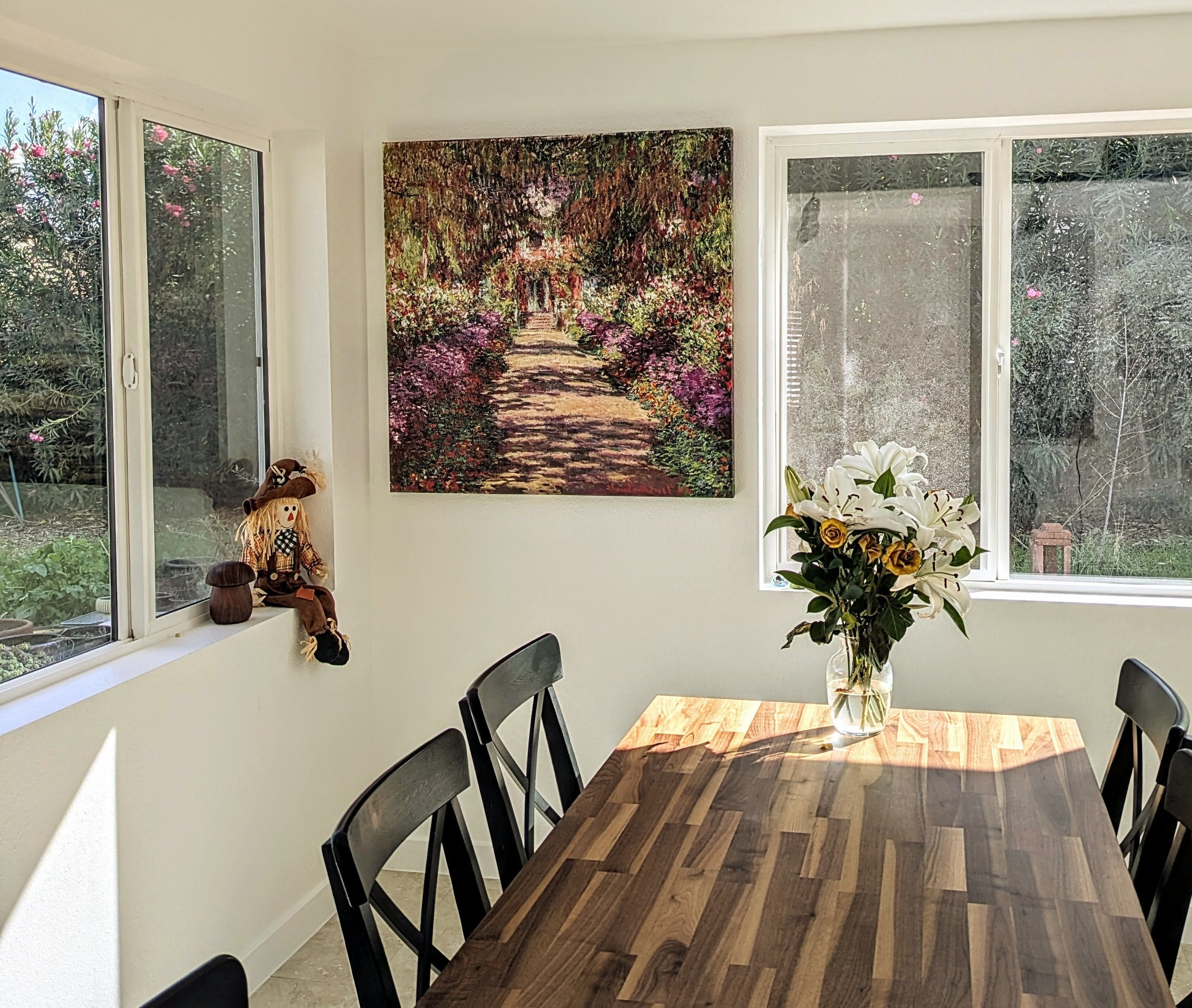
Math is the same.
You must revisit the same problem over and over. Whether multiplication facts, fractions, or long division, every time it gets more clear. It gets easier. Until one day, it flows without effort. And on that day, you become ready for the next puzzle.
Next time your child pushes back about practicing another math problem, show them Monet’s water lilies. Ask them which version is the best, and what would have happened if he’d stopped at one?
4. Make Messes — Be Brave, You Are the Explorer
Ancient maps marked unknown waters with the words Hic Sunt Dracones — “Here Be Dragons.”
No one ever said that exploration was safe and comfortable. It’s scary and hard. One must be courageous to tackle new worlds.
Our children need permission to take chances with problems they don’t yet know how to solve. Some problems will have neat solutions that they’ve memorized. Many will not. Let them try, tweak, and make a mess. Don’t overcorrect. If they get it wrong, help them figure out why. Don’t jump in to tell them right away.
The key message they need to hear is → There are many paths to the right answer. What matters most is the courage to begin.
Model this for your children. My oldest is already doing math I don’t remember. I work the problem myself with her. I tell her I’m not sure how to do it. I show her that I’m struggling, thinking, and figuring it out too. I also will often arrive at the answer differently than the textbook says we are supposed to. It gently shows her there is more than one way to solve a problem — and it’s OK to make a mess to get there.
5. You Don’t Start Good at Math — You Become Good at Math
Most kids think being “good at math” is something you either are or aren’t.
But no one starts out good at math.
You become good by struggling through problems, making mistakes, and trying again. By staying with something longer than is comfortable. Often what separates “math naturals” from everyone else is that they approach the work with a playful heart.
We must help our children see that struggle is a gift — and math is the type of struggle that is surmountable.
Final Note for Parents
Mind shifts take time. You won’t tell these to your child tomorrow and watch all the math drama melt away.
It’ll be more like building a new habit. Like trying to exercise or eat better. It takes time, and there will be missteps, and backward steps. But as long as we keep getting up, progress always follows.
Pick one of the reframes above, work on it through games, stories, and even just gently saying it in times of struggle (I’ve got a list of suggestions below).
Then, pick another.
It may feel slow. Real change always is. But if you pick one mindset shift a quarter (3 months) and you’ve done four in a year!
Your child is worth it.
This week’s bonus for paid supporters is humble, but it includes math puzzle books, curriculum, books about growth mindsets and making mistakes, living books about math concepts, and a free documentary on a mathematician or two. These can be combined to bring the reframes above to life. Scroll down for it.
PS. Would you be interested in a 5-Day Fall in Love with Math Camp? I’m running this camp in my house this summer. I can record a version for subscribers. It’ll include.
At least five recorded lessons that bring each reframe to life with stories about ancient mathematicians and how they influence modern math for your kids to listen to
Fun, low-prep activities, games, and puzzles you can do with your kids at home tied to the lesson to forge a new relationship with math
If 50 or more of you say you’re interested, I’ll put it together and make it available. It will be a paid subscriber bonus.