


If I had to name the model of education we follow, it would be classical.
We read classic literature, study history deeply, use the progymnasmata to teach writing, and ground it all in strong grammar and Socratic dialogue.
I’m a fan — a big fan.
But classical education, as it’s practiced today, is incomplete.
We’re missing something. Something that shaped our great thinkers just as much (if not more) than literature and historical study.
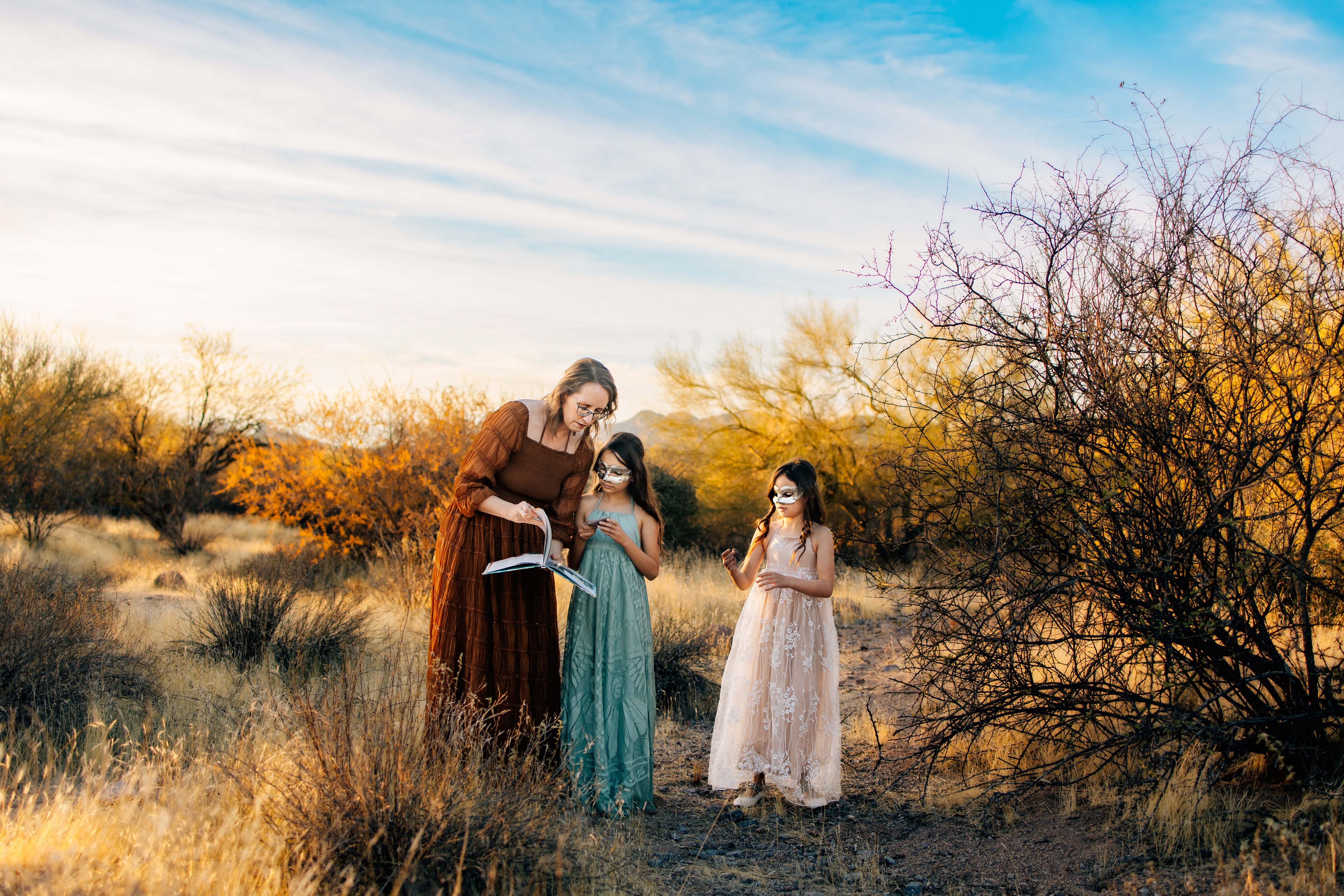
Natural Philosophy.
Natural philosophy, as understood by the ancients, was the pursuit of wisdom through encountering the natural world with curiosity, attention, and awe.
Today, we call it science.
I recently toured two classical schools (one private, one public). When pressed, they admit their science students aren’t well served. They are focused on training the mind and soul through literature discussion (again - I’m a fan!)
But literature, while incredible, does something wholly different than natural philosophy.
Literature takes you outside of yourself through story. It forms you through the exploration of others’ lives: their experiences, their struggles, their quests. It shapes virtue and character through narrative.
Natural philosophy asks something different of you.
It asks you to encounter God’s creation — the natural world around you. It asks you to sit in quiet contemplation of this impossibly complex world, to observe, to question, to seek, to think.
To Wonder.
There is a growing movement to reclaim modern education — to return to the roots of our past.
Why aren’t we reclaiming Natural Philosophy too?
Perhaps, it’s because no one knows how truly beautiful old science was.
When I was a graduate student, we read Sherrington (1857–1952), considered the father of neuroscience. What strikes you immediately is how differently he saw and related to the world.
His scientific study reads like a novel.
He wonders about something, sets out to study it, is surprised. That surprise leads to more questions, and those questions lead him deeper still. He ends not with tidy conclusions, but with reflections about how his work reshapes our understanding of the world and our place within it.
It’s beautiful.
This is how he describes the brain as it wakes.
[The sleeping brain] where hardly a light had twinkled or moved, becomes now a sparkling field of rhythmic flashing points with trains of traveling sparks hurrying hither and thither.
The brain is waking and with it the mind is returning.
It is as if the Milky Way entered upon some cosmic dance. Swiftly the head … becomes an enchanted loom where millions of flashing shuttles weave a dissolving pattern … a shifting harmony ... the body is up and rises to meet its waking day.
~Charles Sherrington in Man on his Nature
Where did this tradition go?
As a professor, I tried to cultivate something similar in my students. But modern academia wants to rush to the next class, read the newest papers, apply to another grant or scholarship.
There was little space for sitting with a question or thinking deeply about what we were actually doing.
You could see this in the student’s work.
Students would run an experiment and immediately push the results through a computer. They would come to my office and say, “I did it.” I would ask, “What did you discover?” They wouldn’t even know where to start answering.
They had completed the steps, but they hadn’t thought about what they were doing or why.
They hadn’t considered what their results meant, or how their work connected to anything beyond the task itself. Nor had they even considered how what they were doing was important or how it added to society as a whole.
You can argue that that is my job as their instructor — and you’d be right of course. But what bothered me so much is that I had to supply even the interest. So many of them weren’t there because they loved it or were seeking some universal truth. They were doing it because someone told them they’d make good money as an engineer.
How depressing.
The “science” education in my home looks very different.
It is far closer to natural philosophy than to modern science instruction.
I want them to think, to observe, to seek, to WONDER.
We don’t begin with instructions. We begin with the world. With questions. With things we notice but don’t yet understand. From there, we look for ways to observe more carefully, to test ideas, to explore what might be true. Sometimes that leads to experiments.
But the experiment is never the point, understanding the universe is.
✨We study the stars not to pass a test, but to wonder how many there are, what they are, and how far they reach into the darkness.
✨We study plate tectonics not to pass a class, but to realize the land beneath our feet is alive—slowly moving, changing, and remaking itself.
Let’s aspire to more.
If you are a classical educator — or really any kind of educator — I encourage you to reconsider how you think about teaching science. It is not the rote execution of experiments or the accumulation of facts.
It is the exploration of an intricate, ordered, and divine world beneath your feet, in the sky, and even inside your literal heart.
It is the practice of disciplined wonder. It is Natural Philosophy.
And I suspect that returning to natural philosophy is one of the clearest ways to draw our children back into reality… away from the abstractions and distractions of a screen saturated life, and into a deeper relationship with the world itself.
Let us raise our children to not merely study the universe — but fall in love with it.
If you resonate with this post, you might enjoy my other work. Joining our community also gives you access to posts like The Four Stories Your Kids Need to Read Everything Else, Curate a Love for Classical Music in Your Children, and my You Can Homeschool course.
Remember → Children are our most important work.
~Dr. Claire
Great points! This is why I love the Charlotte Mason approach, which embraces natural philosophy as well as literature, history, and so much more.
I love this! I have a PhD in the history of science and I focused on natural history and natural philosophy in the early modern period. Suffice it to say, I could not agree more! I can't wait to see where you go with this. I hadn't given it too much thought beyond nature study as a way to engage my kids in Creation writ large, but they're 1 and 4 so there's time...