


When my oldest came home from school, she hated learning.
Wouldn’t pick up a book, cried if we asked her to write anything… don’t even get me started on math.
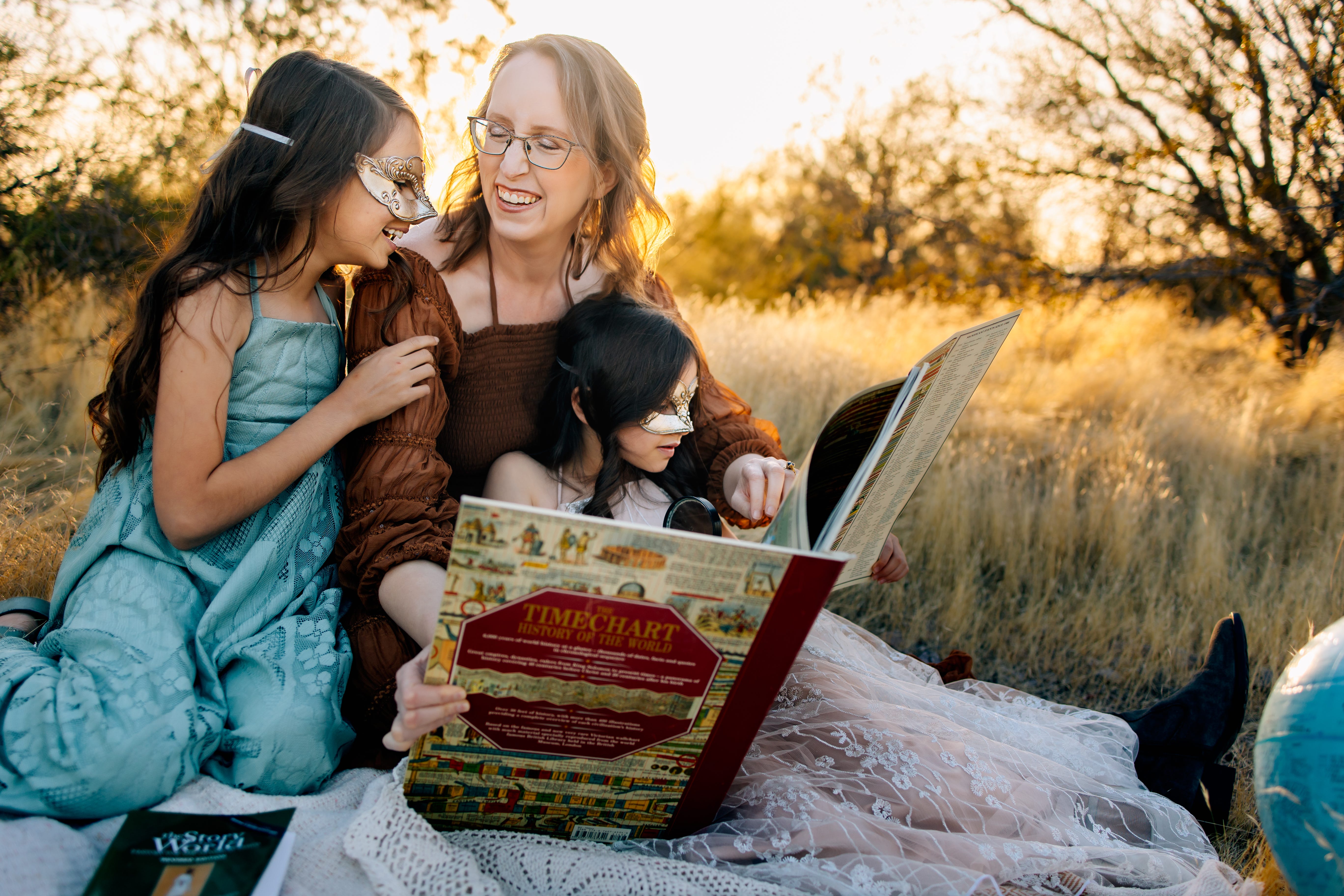
So much of my early research into education was about reigniting a lost love of learning. I read John Holt and Peter Gray. I listened to School Sucks (had far more episodes) and Exploring Unschooling podcasts. They all promoted different versions of child-led, freedom-based, unschooling. It was a beautiful vision — one that transformed my daughter into a lover of books, art, and architecture. I’ll always be grateful for what these minds taught me and for the reawakening of curiosity in my daughter.
But ultimately, it wasn’t enough.
You see, love of learning is just the beginning. It’s what you do next that matters.
It’s my job to leave as many doors open to my children as possible. I want to raise formidable thinkers. I want my children trained in logic, reason, and critical thinking.
There is perhaps no better discipline to train these than classical education. I devoured The Well-Trained Mind and listened to Memoria Press’ Classical Et Cetera podcast. I brought classical literature into our home. We listened to classical music, took art history courses, did deep dives into history, and they are learning to write using the progymnasmata.
Their education was more rigorous than ever.
But here too, something was missing.
The materials were often too tedious, too obtuse. Their writing was improving and they were reading harder books, but I watched that spark of delight slowly dim. I couldn’t let that happen.
So I set out to merge these two seemingly opposite disciplines to create an education that was joyfully rigorous.
An education where my children were both highly prepared (some might argue over-prepared) for their future, while also loving the process.
Let’s take a moment to define these terms, because I’ve noticed people picture them quite differently.
✨What exactly IS a rigorous education?
If you look up the definition of rigor, you will read this: strictness or severity. A harsh or trying circumstance; a hardship or difficulty.
Teachers from Oliver Twist come to mind.
But if you look up the definition of a rigorous education, you will read: an approach to teaching and learning that emphasizes high academic standards, intellectual challenge, and deep engagement with material, while providing the necessary support for students to succeed at those elevated levels.
Charlotte Mason and Maria Montessori come to mind.
Rigor to me does not mean harsh, but it does mean intense. An intensity that builds and grows with children, preparing them for the rest of their lives.
My mother once told me she thought of my education as sharpening a knife. One can’t sharpen a knife with a soft cloth; it requires something harder than steel.
A rigorous education prepares our children. It is necessary and it is right. But is it enough? I don’t think so.
If our children know reading, writing, and math but hate them, we’ve failed.
✨What exactly IS a joyful education?
You may think this term needs no explanation. But I disagree.
There are many influencers showcasing children frolicking around in nature learning joyfully — OK I’m one of them. We’ve had a LOT of these moments. We have them everyday. My children love reading, history, science. They memorize Shakespeare, are learning how to play duets on the piano, and are writing a novel with their best friend — with zero prompting from me.
But not every moment looks like this.

A joyful education does not mean that every moment is filled with joy. Sometimes the most rewarding, the most joyous work of our lives is just that… work. We must push, strive, toil even. Sometimes joy is found at the top of a mountain after the climb.
Motherhood and educating my children is the most wonderful thing I’ve ever done. Every day it brings me joy beyond measure. But it’s hardly perfect. Every day there are challenges, hard moments, tears even. Does that mean it’s not joyful work? Absolutely not.
Our children’s education will require them to do hard things. It will not always look joyful. But if we remove the challenges, we also remove our children’s opportunity to conquer.
There are few things more joyful than hard-won success.
Don’t take that from your children.
✨Our job is to find Joyful Rigor
To raise children who can think deeply, work hard, and still remain full of wonder.
This is why I refuse to choose between joy and rigor.
My children deserve both. And so do yours.
Over the years, I’ve worked to find this balance not only with my own children, but with many students beyond them.
When I worked as a university professor, I saw the same pattern repeat: bright students whose love of learning had been extinguished. I used all the modern techniques (flipped classroom, student-led, mastery-based), but I turned to the ancients for my own children (Socratic dialogues, Progymnasmata, etc.).
Memory fades, so I laid out everything I’ve learned about giving children a joyfully rigorous education from preschool to the start of middle school.
The whole collection nearly complete below.
Falling in Love with Learning: A Joyfully Rigorous Guide to the Preschool Years
✨Falling in Love with Reading: A Joyfully Rigorous Guide to Ages 5-7
Deepening a Love for Reading: A Joyfully Rigorous Guide to Ages 8-10
✨Falling in Love with Writing: A Joyfully Rigorous Guide to Ages 5-7
Deepening a Love for Writing: A Joyfully Rigorous Guide to Ages 8-10
✨Falling in Love with Math: A Joyfully Rigorous Guide to Ages 5-7
Deepening a Love for Math : A Joyfully Rigorous Guide to Ages 8-10
This Falling in Love with Learning series will showcase the core of the ClarifiEd philosophy that I developed over decades. It draws on my experience as a university professor, microschool and club leader, homeschool mom, and my background in neuroscience and how the brain learns best.
It will compliment, update, and expand my You Can Homeschool course.
I’ve been wanting to write this for a very long time.
✨Now is the time.
I’m so excited — and I hope this approach will transform how your children experience learning too.
I hope you’ll join me♥️
Remember → Children are our most important work.
~Dr. Claire Honeycutt
As a student I found the most joy in rigor… in finding a new challenge and being able to say to myself…”Look what you achieved.” How can you not find joy in that as a young person? As a person at any age?
I really appreciate this perspective - the 'both/and' approach for having both rigor AND joy. I explore the conditions that cultivate human flourishing, and this reminds me of two of the conditions: learning & mastery (progress in areas of meaningful interest) and open-ended play & joy (following curiosity and interests). Both are crucial, so an educational approach that focuses on one at complete expense of the other will naturally sacrifice something important for children (and for all of us!). Thanks for sharing and the series that you're writing this summer sounds fantastic!